|
|

| Title: Date of the Day - Science and Industry | |
| Generalhistory > General > General Discussion | Go to subcategory: |


| Author | Content |
MarkUK

|
|
|
Date Posted:2026-01-01 08:42:52Copy HTML 1 January 1781 - The World's First Iron Bridge Opened. In 1776 a proposal to construct a wholly metal bridge across the Severn Gorge between the Shropshire villages of Benthall and Madeley was put before Parliament. The necessary Act was passed with the the work for the design going to Thomas Pritchard and the actual casting and construction to Abraham Darby of the Coalbrookdale Ironworks, Shropshire. Work began in 1777 and although the river was spanned as early as July 1779 the bridge was not formally opened to traffic until New Year's Day 1781. It is 100 ft long weighing 378 tons. Such was the fame of the construction that the town that grew up around the two villages was renamed Ironbridge. Closed to road traffic in 1934 it remains in use for pedestrians.
You're playing chess with Fate and Fate's winning.
Arnold Bennett
|
|
MarkUK
|
Share to:


 #951
#951
|
|
Re:Date of the Day - Science and Industry Date Posted:2026-08-31 07:22:56Copy HTML 31 August 1913 - Sir (Alfred Charles) Bernard Lovell born. GB's most prominent astronomer of the 20th century, Director of the Jodrell Bank Observatory for 35 years. Jodrell Bank is GB's premier astronomical site and was formerly part of the early warning system for incoming Russian missiles. It was also once the largest steerable radio telescope in the world and in 1987 was renamed the Lovell Telescope.
You're playing chess with Fate and Fate's winning.
Arnold Bennett
|
shula

|
Share to:
#952
|
|
Re:Date of the Day - Science and Industry Date Posted:2026-08-31 09:44:42Copy HTML That is a very impressive piece of equipment. Are visitors allowed?
"It is forbidden to spit on cats in plague-time."
-Albert Camus-
|
|
tommytalldog
|
Share to:
#953
|
|
Re:Date of the Day - Science and Industry Date Posted:2026-09-01 12:20:56Copy HTML 31 August 1913 - Sir (Alfred Charles) Bernard Lovell born. GB's most prominent astronomer of the 20th century, Director of the Jodrell Bank Observatory for 35 years. Jodrell Bank is GB's premier astronomical site and was formerly part of the early warning system for incoming Russian missiles. It was also once the largest steerable radio telescope in the world and in 1987 was renamed the Lovell Telescope.
Looks like the crazy uncle you wouldn't leave your children alone with. |
|
MarkUK
|
Share to:
#954
|
|
Re:Date of the Day - Science and Industry Date Posted:2026-09-01 05:22:01Copy HTML It's open to the public, but under threat of closure in 2028 unless funding can be found. I visited years ago, Art will have been, it's not far from where he lives. Sir Bernard died aged 98 in 2012. You're playing chess with Fate and Fate's winning.
Arnold Bennett
|
|
MarkUK
|
Share to:
#955
|
|
Re:Date of the Day - Science and Industry Date Posted:2026-09-01 07:47:51Copy HTML 1 September 1985 - The discovery of the wreck of the Titanic. Commissioned by the US Navy to search for the wrecks of two submarines lost in the North Atlantic in the 1960s Robert Ballard of the Woods Hole Oceanographic Institution in his ship Argo located the lost vessels in 1984 thus proving the viability of his method of deploying a robotic submersible Jason to carry out the search. After the end of a second mission to map the wreck of the USS Scorpion in the summer of 1985 12 days was allocated for Ballard to search for the Titanic. Using the method of towing Jason up and down a designated search area the first debris from the stricken liner was spotted in the early hours of 1 September. By following the debris trail they came upon the stern section with the bow 2000 ft away. Only then did they realize that the Titanic broken in two on its descent to the sea floor 2.36 miles down.
You're playing chess with Fate and Fate's winning.
Arnold Bennett
|
majorshrapnel

|
Share to:
#956
|
|
Re:Date of the Day - Science and Industry Date Posted:2026-09-01 08:04:51Copy HTML 31 August 1913 - Sir (Alfred Charles) Bernard Lovell born. GB's most prominent astronomer of the 20th century, Director of the Jodrell Bank Observatory for 35 years. Jodrell Bank is GB's premier astronomical site and was formerly part of the early warning system for incoming Russian missiles. It was also once the largest steerable radio telescope in the world and in 1987 was renamed the Lovell Telescope.
I’ve never been in it, but I have passed it 100 times and it never ceases to amaze you. In the early years of the Russian space program it became invaluable to the allies in tracking the Russian space program. |
|
shula
|
Share to:
#957
|
|
Re:Date of the Day - Science and Industry Date Posted:2026-09-01 09:01:31Copy HTML He was probably a very rich uncle, Tom. That might lead some parents to relax their definition of good parenting skills.
"It is forbidden to spit on cats in plague-time."
-Albert Camus-
|
|
tommytalldog
|
Share to:
#958
|
|
Re:Date of the Day - Science and Industry Date Posted:2026-09-01 09:48:53Copy HTML He's got that "dozent" look Shula as my late Mum-in-law used to say. Dunno if that is a word or not. |
|
MarkUK
|
Share to:
#959
|
|
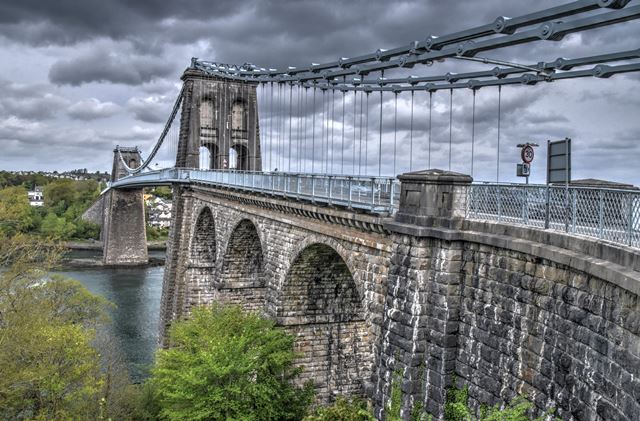
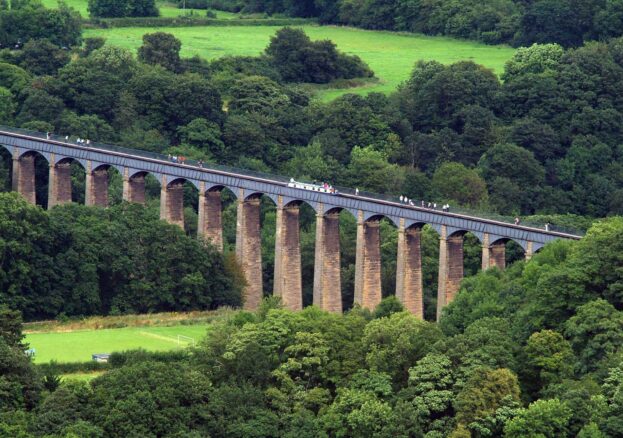
Re:Date of the Day - Science and Industry Date Posted:2026-09-02 07:36:31Copy HTML 2 September 1834 - Thomas Telford died. The greatest civil engineer of the 18th/19th century. Born in Scotland the self educated son of a shepherd Telford was apprenticed to a stonemason becoming involved in works across Scotland before moving south where his skills were fully realized. In his 40 year career he designed and built structures - bridges, canals, aqueducts, docks and harbours. His most famous are still in use today; the Menai Suspension Bridge linking mainland Wales to the island on Anglesey and the spectacular Pontcysyllte Aqueduct over the Llangollen Canal.
You're playing chess with Fate and Fate's winning.
Arnold Bennett
|
|
shula
|
Share to:
#960
|
|
Re:Date of the Day - Science and Industry Date Posted:2026-09-02 10:35:04Copy HTML What magnificent structures. They're breathtaking.
"It is forbidden to spit on cats in plague-time."
-Albert Camus-
|
|
MarkUK
|
Share to:
#961
|
|
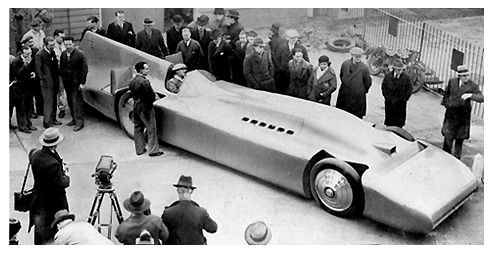
Re:Date of the Day - Science and Industry Date Posted:2026-09-03 08:00:33Copy HTML 3 September 1935 - The first person to travel at 300mph on land. Although aircraft had flown at over 300mph since the late 1920s the first 300mph+ record was set by the Englishman Sir Malcolm Campbell in the Campbell-Railton Blue Bird at the Bonneville Salt Flats UT when he reached 301.337mph. Blue Bird is preserved at the Daytona International Speedway FL.
You're playing chess with Fate and Fate's winning.
Arnold Bennett
|
|
tommytalldog
|
Share to:
#962
|
|
Re:Date of the Day - Science and Industry Date Posted:2026-09-03 10:50:47Copy HTML 3 September 1935 - The first person to travel at 300mph on land. Although aircraft had flown at over 300mph since the late 1920s the first 300mph+ record was set by the Englishman Sir Malcolm Campbell in the Campbell-Railton Blue Bird at the Bonneville Salt Flats UT when he reached 301.337mph. Blue Bird is preserved at the Daytona International Speedway FL.
I remember his son Donald who was killed in his Blue Bird boat trying to break the water speed record. He died without the "Sir." |
|
majorshrapnel
|
Share to:
#963
|
|
Re:Date of the Day - Science and Industry Date Posted:2026-09-03 12:32:09Copy HTML 2 September 1834 - Thomas Telford died. The greatest civil engineer of the 18th/19th century. Born in Scotland the self educated son of a shepherd Telford was apprenticed to a stonemason becoming involved in works across Scotland before moving south where his skills were fully realized. In his 40 year career he designed and built structures - bridges, canals, aqueducts, docks and harbours. His most famous are still in use today; the Menai Suspension Bridge linking mainland Wales to the island on Anglesey and the spectacular Pontcysyllte Aqueduct over the Llangollen Canal.
He was nicknamed 'The Colossus of Roads' a referenced joke to the wonder of the world, The Colossus of Rhodes, because of his prolific building of hundreds of miles of stone roads. His level of achievement in the field of engineering and construction stands alongside Isambard Kingdom Brunel, the greatest engineer in history. Britain was just a criss cross of mud and gravel paths stretching around the country until Telford arrived. There were stone roads but very few. In the late 1600's it took a minimum of four days on dry ground to travel from London to Birmingham, a distance of around 110 miles and sometimes up to a week. There were stone roads in the time of Telford but strangely Telford was the man who came up with the idea of camber to keep them dry. Telford's roads paved the path of the industrial revolution and e was the first man to install drainage to them. Incidentally Tom, it was also another two Brits who invented smooth modern roads, tar Macadam. A Scot and a Welshman. Like Brunel it is difficult to grasp the sheer magnitude and proliferation of his works and talent. He should be more known for his canal building and work in hydraulics too. A truly visionary man who needs to be lorded in every classroom. |
|
majorshrapnel
|
Share to:
#964
|
|
Re:Date of the Day - Science and Industry Date Posted:2026-09-03 12:53:24Copy HTML
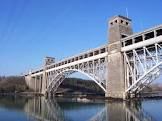
This bridge runs alongside Telford's suspension bridge into Anglesey. It was built by Robert Stevenson, yup, son of the great George Stevenson, the man who brought us the first modern steam train and it's still in use today. It's a railway bridge, once a tunnel because the rails inside went through a wooden tunnel, which burnt down. They never replaced it. |